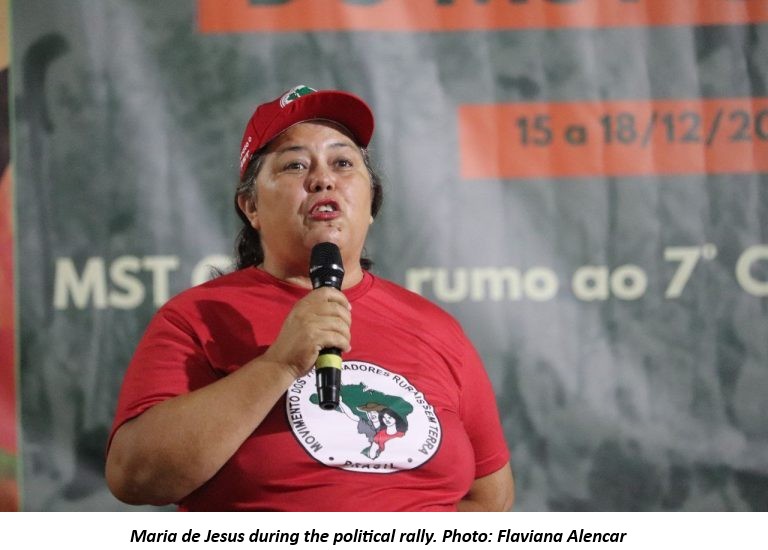
This interview with Maria de Jesus dos Santos Gomes—state coordinator of the MST (Landless Workers' Movement) in Ceará—covers aspects of her life, highlighting memories of hunger in her community, solidarity initiatives, and her participation and organizing work within Via Campesina through the MST in the state.
By Francisco Regis Lopes Ramos* and Kenia Sousa Rios**
From the academic journal *História Oral* (Oral History)
The interview took place at the Frei Humberto Training Center in Fortaleza on the evening of May 20, 2026. Maria de Jesus was waiting for us after spending the entire day selling her produce at an Agrarian Reform Fair held in Fortaleza at the time. We chose the Frei Humberto Training Center—a space dedicated to various Via Campesina activities in Ceará—as the venue for the interview. We settled into the auditorium named in honor of the poet Patativa do Assaré; surrounded by slogans of the struggle for land and life adorning the walls, we began our conversation.
Francisco Regis and Kenia Rios – We would like you to introduce yourself: your name, your birthplace, and how you would like to be introduced in this RBHO publication.
Maria de Jesus – I am Maria de Jesus dos Santos Gomes. I was born in the community of Ipueira dos Gomes, in the municipality of Canindé, Ceará. I was born on June 18, 1971. My birthplace, Canindé, is a municipality in the semi-arid region. I am part of the MST-CE state coordination team.
FR and KR – We’d like you to tell us a bit about your story—striking childhood memories, what the place was like, and especially what you ate. How you accessed food—whether you grew it yourselves, how you farmed, and what the main challenges were. That sort of thing. Just tell us whatever comes to mind.
MJ – Well, I’m the daughter of small-scale farmers, though, you know, my father had ten hectares of land. There are six of us siblings, so that land belonged not only to my immediate family but also to my uncles and aunts. We were the children of small-scale farmers—I am the daughter of small-scale farmers. We engaged in subsistence farming there, growing beans, corn, squash, cotton, and potatoes. During the dry season, my father would plant crops in the fertile lowlands; we also raised goats and cattle—we had cows. My grandfather was a cattle rancher, so we never lacked milk. So, what was the major hardship I faced during my childhood? It was the drought period from 1979 to 1983. Here in the Northeast, we went through a period that some describe as an ethnocide. Just imagine—I was between eight and twelve years old at the time. Throughout that drought, people in my community were dying every week. One thing really troubled me: we were involved in catechism and First Communion classes—participating in the "Perseverance" program—and it was our duty to attend every funeral, singing and praying. That really bothered me because I thought, "I don't believe God is killing us. I don't believe we are being punished." That was the first thing that made me question things. Later, in 1987, I took a catechism course at the São Francisco Catechetical Institute, a school run by the Diocese of Fortaleza. That’s where I met Dom Aloísio and had the opportunity to meet Father Luiz, Father Hermano, and so many others associated with Liberation Theology; that was when I began to understand that the drought wasn't a matter of God punishing us—it was a class issue. Because back in Canindé, the councilmen didn’t go hungry, the merchants didn’t go hungry—no merchant lost a son or a daughter, nor did the elderly person who was, let’s say, wealthy, or a bank employee or a civil servant; those people didn’t go hungry. But us farmers... Yes, we went hungry; my brother died—my brother died, you know...
FR and KR – And did he die of hunger? Did you understand it as dying of hunger?
MJ – He died of diphtheria... Diphtheria was the disease of hunger; it was malnutrition—it caused diarrhea, and the child would die within 48 hours. The fontanelle would sink in—as our parents used to say—and they would die.
FR and KR – But did you say that? Did you feel it was caused by hunger? Did the illnesses come from hunger?
MJ – It was from hunger. The illnesses we had and faced were caused by hunger. It was parasitic infections—caused by hunger and poor conditions. And water? There was no water there. Would you believe I used to... Back then, I’d haul 13 cans of water; my chore was fetching water for the family. I only ever had the hard chores. My job was fetching water and firewood. I was the oldest.
R – And where did the water come from?
MJ – The water came from a river right next to my house. But the thing is, during the dry season, the water level in the well would drop way down. We had to climb way down to get it; we’d arrive at 5 a.m. and leave at 9 a.m. just to get 20 liters of water. You see, that’s the big difference I see in the Northeast today. My parents' house now has a deep well with a flow rate of 5,000 liters per hour—water to serve the local community. There are several deep wells there now, and piped water in people's homes. No one has to suffer the way I did, carrying water on their head. And that’s thanks to the policies of Lula and Dilma.
KR – Did you have to walk far to the water source?
MJ – We did walk. I’d walk about 300 meters to fetch that water. And it was such a struggle. Fetching that water—and it was brackish; not quite as salty as the water found in many parts of our semi-arid region, but that was the reality. And later on, for our drinking water, we’d travel a league away with a donkey to fetch it from neighboring reservoirs in our community. So, the issue of water, thirst, hunger, the death of animals, the lack of food—that was something we lived through. We didn't starve to death in our community only because we had a nun in our family; she managed to get basic food baskets from the Fortaleza diocese. She would bring them every two weeks, along with a truck driver who was also part of our family—Josy and Maria, the sisters, would bring them to our community, and that’s the support we received. That’s the only reason we didn't starve.
R – Tell me something... You mentioned goats—you had goats. Were goats very important?
MJ – Yes.
R – Tell me why.
MJ – Well, because goats belong to the semi-arid region. They are adapted to it. Raising goats doesn't require a lot of feed, unlike cattle, for example. With very little food, you can keep a herd and have milk. To give you an idea, back then, for our morning snack, my mother would make goat milk with *jerimum*—pumpkin—which my father grew on the receding banks of the reservoirs. We ate it every day. To motivate us, Dad would say, "Eat up! Whoever eats pumpkin and goat milk every day gets strong legs and beautiful hair." Dad would use beauty as an incentive, you know? It made us feel like eating the same thing every day was natural.
KR – I’d like you to talk more about that—what was the diet like? What did you eat in the morning, later on, and at night?
MJ – Well, during the rainy season, there was plenty. We had livestock—chickens—and corn. You can make so many dishes from corn: *mugunzá*, *pamonha*, *canjica*... […] We grew corn, too. So, when the rains came, our table was full. Mature beans, regular beans, *baião de dois*... So, we had plenty when the rainy season came. But during the drought—look, we’d start the day by going out to look for... do you know what? Carnauba fruit. We’d go knock down carnauba fruit, *juá* fruit.
KR – And how do you prepare that to eat?
MJ – No, for the *juá* fruit, we’d knock it down—we’d go around chasing away the bees, you know? So, wherever we found it, we’d throw a stick, knock the fruit down, gather it, and eat it. You understand? Those fruits—wow, I think carnauba fruit is delicious.
KR – And there wasn't any preparation involved? You’d just knock it down and eat it?
MJ – No, we’d knock it down and eat it right there. And later, at lunchtime, it was *caldo de bila*. My mother calls it *caldo de bila*. She would take... sometimes—look, just to give you an idea, I remember this so well. Then, when relief aid arrived from Caritas with food donations, things changed, right? We had at least rice and beans every day; we had something—we didn't have a protein to go with it, but we had the basic grains. I ate a lot of rice and beans with a spoonful of oil—I’d stir it all together and mash it up. I ate it with such relish; it was satisfying. But what I mean is, that was a situation of hunger. It was sugar cane juice. Sugar cane juice for us. Goodness, it was so good. We’d have sugar cane juice as a snack. Coffee with cassava flour. Coffee with cassava flour. We ate a lot of coffee with cassava flour. There was no such thing as crackers or cookies. We didn't have those things. It was coffee with cassava flour. So we ate that... It tasted great—it was truly a diet for an emergency hunger situation, you know? But later, when we discovered that this is a matter of class... ...and the fact that we can go through a drought without suffering from thirst or hunger, without seeing a single animal starve to death—I think that is the major innovation the MST brought to Canindé. Look, when the MST arrived in Canindé, that all changed. Today, Canindé goes through droughts, but the people no longer die of hunger. Just look at the statistics: since the MST arrived in the municipality of Canindé in 1989, have people been dying during droughts? No—there is struggle. During the last drought there, we secured a massive food basket—130 kg. It wasn't some meager handout; we also established work programs and demanded the conditions necessary for survival, because the struggle introduces this new dimension. Before, we used to plead with Saint Joseph, making vows and turning the saint's statue upside down—doing all those things to bring the rain, saying prayers. Not that we stopped asking Saint Joseph for the blessing of a good rainy season, but we eventually discovered that we needed actual policies. That is the contribution the MST brings to us—to us workers and farmers. So, in the *Sertão Central*, the MST introduces this new dimension that goes beyond mere looting. Looting happens, yes, but there is also a demand for mediation with the Brazilian State and society to provide emergency solutions for the drought period. Today, we have policies for living in harmony with the semi-arid region—policies systematized by the Semi-Arid Network (*Articulação do Semiárido*). These are policies rooted in over 400 years of popular resistance by the people of the Northeast, because we know what a *baixa* is. A *baixa* in the *sertão* means abundance—those areas near rivers and streams. They are areas where you... well, a subsurface dam makes all the difference. Or a large hand-dug well, an artesian well, or a reservoir.
KR – And the cisterns?
MJ – The cisterns. Look, you have no idea. Before we had cisterns—today, a cistern is a precious family asset. We take care of the cistern; at my house, for instance, we are very careful with the water that goes into it—making sure it doesn't get contaminated, keeping it tightly sealed so nothing gets in... Before, with the water we had in the *sertão* [backlands], we used to have so many problems with diarrhea. So many issues with intestinal worms, water full of mud—muddy water, water full of... Not anymore. Now we have cisterns. Depending on the family, the water lasts from one rainy season to the next. That drinking water... well, that problem is gone. It’s rare for someone to get diarrhea or an intestinal infection in the *sertão* now—at least where there are cisterns, we don't have those health issues. Because those kinds of diseases are linked to water access. So, it’s a crucial matter. As for the cistern—my mother... in our community, we got one of the first ones; one went to my house. We received it from Friar Humberto. He was a priest from Canindé.
KR – The one this place is named after, right?
MJ – Yes, our training center is named after him. Friar Humberto donated them—he did this for several communities and donated one to us, the movement activists. So, I installed it at home. And let me tell you, that made all the difference. My mother treated that water with such care—my father, me, everyone—it was a treasure. It *is* a treasure.
KR – It was something sacred...
MJ – […] to us, water is sacred. I can't get used to this idea of buying water. It makes me indignant because, to me, water is a gift from nature, a common good. It isn't meant to be commodified. So, I think the cistern—water storage—is key; the movement talks about water storage now.
KR – Storage?
MJ – What does that mean? It’s not just about having water for emergencies—no. It’s about having enough water to last five years if a drought hits—water for our animals, for human consumption, and for productive use.
R – And having water on the land is crucial. What happens to the land without water?
MJ – It’s very difficult. And the issue of water is also tied to the forest—to preservation. The MST has this wonderful campaign—planting and producing healthy food—which is fundamental. Planting trees affects climate change. We have to preserve our biome, the Caatinga; we have a unique biome here. So, we take care of that. Today, the knowledge and political struggle of people’s movements have been essential in changing how we coexist with drought—showing that we can get through a drought while still producing food. We’re learning this through rural schools. Rural schools—which now offer technical courses in agroecology—are making a huge difference in our territories. The agricultural schools here in the state of Ceará are making a real difference by educating the peasantry on how to resist during the drought and coexist with it.
KR – Can you give some examples of that? What do people plant during droughts to help alleviate hunger?
MJ – We’ve focused on four types of sovereignty. We talk about forest sovereignty—the importance of planting trees, especially those native to our biome, and prioritizing fruit-bearing trees from our region. There are several fruits that produce during the drought—*umbu*, *cajarana*, *seriguela*, and *ata*. So, we’ve been focusing on cultivating resistant trees—fruit-bearing ones that provide food but also withstand the climate during dry spells. There’s also the matter of forage crops—fodder cactus, sisal, and others, even the *mandacaru* cactus. Why not cultivate *mandacaru*? We’ve encouraged the use of hardy grass varieties, too. Making the most of everything—that’s something Father Cícero used to teach. He taught that very thing.
R – "If every pilgrim plants a tree, the *sertão* will change." That’s what he used to say.
MJ – That’s an age-old teaching. So, we aim to cultivate and promote that. I remember a time in Tamboril—it’s a very dry place. I visited the home of Dona Isabel, a long-standing leader in our Monte Alegre settlement. It was the height of a drought—three years without rain. Yet, when I stepped into Dona Isabel’s backyard, I saw a beautiful vegetable garden. The fruit trees were stunning—papaya, sugar apple... It felt like being in an oasis. It’s not large-scale extensive farming, but rather small-scale agroecology that meets the family's needs—and even the community's. These little oases create a whole new dimension, especially when you consider the integration of livestock raising... ...animals.
R – I’m curious: does the goat remain just as important?
MJ – It does; in the *sertão* [backlands], it certainly does.
KR – Jesus, I wanted to go back to the point you were making—so I can understand, and so you can explain to us—what the difference is between food sovereignty and food security. Why do you use the term "sovereignty"?
MJ – Look, food security is about access to food. That food might be contaminated with pesticides; it might come from large-scale agribusiness. But it guarantees that the population has access to food, regardless of quality. So, that is one way—it guarantees food security. But the criterion is simply accessing food. It could be genetically modified food or food contaminated with pesticides; for food security policy, that doesn't matter. What matters is that people have access to food. That constitutes a guarantee of food security. This is a concept heavily promoted by the UN; it was systematized by the UN and the FAO. Now, what is food sovereignty? That concept was developed by the global peasant movement. It was systematized by La Via Campesina International. And today, it is a rallying cry in the 168 countries where La Via Campesina operates. It is one of the central causes in the struggle of peasant men and women.
MJ – And what do we understand by food sovereignty? Our understanding of food sovereignty starts with control—specifically, having land to produce on. It’s about access to land and the right to land. In the current international context—and given the shift in capitalism toward the hegemony of financial capital—land has turned into a financial asset. So today, the issue of land concentration and the expropriation of land from peasants—including here in Brazil—has accelerated rapidly over the last twenty years; current levels of land concentration are comparable to those seen during the era of Brazilian colonization.
R – And monocultures?
MJ – […] monocultures. So, what happens? Access to land is the primary condition for food sovereignty. And the other issue is control over how that production is organized—ensuring we have seeds, the right management practices, and diversified planting that meets the needs of the nutritional pyramid; ensuring we can produce food containing minerals, proteins, carbohydrates, and vitamins. So, we need to think about our production with an eye toward food sovereignty and healthy, nutritious food. Because you might have a situation where you’re eating—where food is abundant—but it might only be nutritious in terms of carbohydrates, for example. Where are the minerals? Where are the vitamins? Where are the proteins? This is causing a major health problem in society today: obesity. Poor diet is leading to obesity, which in turn causes other health issues.
KR – Which is a form of malnutrition.
MJ – Which is a form of malnutrition. So, the importance of thinking about food sovereignty in terms of producing healthy, nutritious food—incorporating this entire understanding—is something we are working on with all the peasant farmers. And for us, there is another new aspect. Agroecology, for us, is a way of organizing our production. But we—the MST, in fact—break with a certain view of agroecology, because when agroecology first emerged, there was no talk of the "three matrices"—since agroecology does have three matrices. It has an ancestral matrix—the ancestral knowledge of agriculture from before the Green Revolution, before the use of agrochemicals. There is a vast body of knowledge from that type of agriculture; we’re talking about 12,000 years of knowledge, right? ...from that production of healthy food. But later, with the arrival of the Green Revolution—especially from the 1950s onwards here in Brazil—there was a massive shift in Brazilian agriculture toward a corporate, capitalist model aimed at commerce. This trend has intensified in recent years with the commodification of food. When the WTO turned food into a commodity—a mere tradeable good—we peasants across the globe understood that food is a common good. It cannot be a commodity. It cannot be a commodity. For us, nature cannot be a commodity. Land cannot be a commodity. Land cannot be a mere tradeable good. Air cannot be a tradeable good. Water cannot be a tradeable good. Food, too, cannot be a tradeable good. For us, food sovereignty encompasses the issue of controlling production—from access to the land for planting, or peasant control over the land (since we do not sell our land), through the entire process of management, harvesting, and marketing—in a way that meets the family's needs and provides income from the surplus.
MJ – So that we can offer this food to society as well. But it must be healthy food. We have been arguing that our great task—as peasants—is the production of healthy food. And in Brazil, 70% of food is produced by us, the family farming sector. It is the exact opposite [of the dominant model]. We receive minimal investment for our production, whereas agribusiness—let's say—has trillions invested in theirs; a type of production that contaminates the soil, the air, and people, driven solely by commercial interests—such as generating the so-called "primary surplus." This fuels the new phase of finance capital, but it does not allow society to have access to healthy food.
R – I recall that in 2003, Stédile published a text titled "Seeds Are the Heritage of Humanity: Against the Privatization of Seeds." What is the status of this issue today?
MJ – It remains a major campaign for us—the issue of seed preservation, conservation, and reproduction. In fact, we in the MST have an initiative called Bionatur—a cooperative of ours—that is currently expanding nationwide with this very goal. It originated in Rio Grande do Sul and focuses heavily on vegetables, but we are scaling it up to handle the reproduction of various seed types across Brazil, tailored to the specific biomes. After all, the movement has been making strides in studying these biomes. And we are engaging in a wonderful dialogue regarding how to make the most of our produce. For instance, I am part of an initiative in my community that processes cashew fruit and nuts. My family currently produces 14 different items from the cashew; we utilize the cashew apple itself. We... ..that’s what we do there. I’m using the cashew as an example here, but we can do the same with cassava—manioc. We can do it with the *umbu* fruit; it can yield various by-products. Corn, goat milk, cow’s milk—you see? So, we need to refine things. It’s not just about the concept of an agro-industry—thinking only of food processing or altering the food itself. No. For instance, I’m part of an agro-industry—we’re just getting started; we’re a group of women producers. We’ve just established our processing facility. We produce cashew nut derivatives. What do we make there? We make 14 different products. We make cashew nut paste, cashew nut cream cheese, cashew nut cookies, cashew nut cereal bars, cashew nut milk, and cashew nut *doce de leite* (milk caramel). We’re also making... caramelized cashews with demerara sugar, roasted cashews... ...cocoa; it’s a product made with cocoa and nut paste. We make nut *paçoca*, which is delicious. We...
KR – My mouth is watering (laughs).
MJ – […] We make flour from the nut—we make nut flour—and we make bonbons, wonderful nut bonbons. We make an aged cheese that actually has a three-month shelf life. These 14 products are lactose-free, gluten-free, trans-fat-free, and sugar-free; they are products that address climate change. Because, for instance, regarding dairy products—cattle are major emitters of gases affecting the ozone layer—so we are engaged in this type of production. It’s a women’s group, but it involves the whole community in the production process, and we really focus on making full use of the nut—you know, it’s a very important issue. And for nine of these products, we don’t use a drop of water. Nine products—we use no water. I’d call it—let’s put it this way—an agro-industry of the semi-arid region. Just imagine how beautiful a production process like that is.
KR – One that engages with and respects the Caatinga biome.
MJ – One that values our own produce; after all, we are cashew and cashew-nut producers there. And with the cashew fruit, we make *cajuína*, cashew syrup, and cashew wine. We make four types of cashew sweets—including one where we sweeten the cashew confection with cashew syrup; I call it a delicacy. We also make cashew *rapadura* [unrefined cane sugar block].
KR – Cashew "meat"?
MJ – […] We also make *canjirão*. We make cashew "meat," too. And we make cashew vinegar. It’s delicious. So, I want to tell you that this is all about rural, traditional knowledge—valuing our own production. And, at the same time, valuing a plant native to the Caatinga: the cashew tree. The cashew is ours. So, regarding food sovereignty—and I’m using the cashew as an example here (the nut is the actual fruit, you know? Not the fleshy part)—it’s a plant where we utilize every single part. We have many such plants in our Caatinga biome—sacred plants—that allow us to build resilience and coexist with drought. That way, we won’t go hungry.
KR – And is it not large-scale farming? How is the produce marketed?
MJ – Well, we are working on this experience. The discussion around food sovereignty centers on the concept of controlling our own production with peasant autonomy. The goal is to meet the family's food needs—keeping our nutritional pyramid in mind, because it’s important not to lose sight of that, and focusing on food quality—while also considering society. We want to produce on a larger scale to supply society and generate income for our families to meet all their needs. So, we are undergoing a transformation. The kind of peasantry we in the movement are fighting for is one that possesses knowledge, education, and access to technology. Right now, our movement is fighting to secure machinery. Food sovereignty goes hand in hand with other forms of sovereignty. We’ve been having wonderful discussions about agroecology with rural schools here in Ceará and across the Northeast, as well as within the movement as a whole. What does the agroecology we champion actually entail?
Forest sovereignty—which means preserving the biome, or rather, the biomes; after all, Brazil has six of them. It’s about caring for these biomes. We see ourselves as guardians of the biome. The movement launched a major campaign called the National Plan for Planting Trees and Healthy Food, with the aim of valuing the trees in this biome that provide food.
Water sovereignty - It is fundamental, yet today it poses a problem across all our country's biomes—due to deforestation, burning, and all those associated processes. So, we are discussing water sovereignty, food sovereignty, and forage sovereignty.
After all, if I’m raising livestock, I need to produce feed for my animals so we don’t become dependent on others. In the semi-arid region, for instance, there are people who spend half their pension just buying animal feed. We need to produce our own forage so that the pension income can cover the family's other needs.
Then there is energy sovereignty... We understand the importance of renewable energy, but not according to the logic of solar energy corporations. We oppose that model. We favor small-scale plants that supply local territories and meet our irrigation needs. There is also wind energy, which alters the entire environment. People can't live nearby... the wildlife disappears, the water dries up. So, we oppose this model of "energy latifundia"—massive, centralized energy estates. What we want is renewable energy based on a distributive model.
Another important issue for us is economic sovereignty—something we, as peasant farmers, need to consider. Look, if we are in a drought period, raising... Raising small animals is something achievable; if you raise chickens, you get eggs and meat. So, how do we boost small-animal husbandry during times like these? With goats, you get milk. How do we derive value from that? If we can't plant beans or corn due to a lack of water, how do we ensure production for that period? We have to think about production in terms of cycles. Peasant economics in the semi-arid region is a subject I study firsthand. I strongly encourage people in the encampments and settlements to dream—to have dreams. I tell them: "Folks, we can't think about our economy the way a large-scale rancher does, because we are different. First, we don't have the same conditions. And second, we don't even *want* to be like them. We have a different vision for the countryside, for agrarian reform, and for agriculture. We want an economy that meets our human and social needs—one that enables a dignified quality of life in rural areas." We in the MST want a life with education, culture, healthcare, and social rights—all the rights we are entitled to: political, social, and economic. We don't want just one right—say, just the land; we want all of them. In this sense, economic sovereignty means looking at the various possibilities for raising animals and growing crops—such as small vegetable gardens and fruit—while keeping our specific needs in mind.
Another issue is medicinal sovereignty. We have been cultivating ancestral knowledge here in Brazil; we possess a wealth of ancestral wisdom regarding the use of plants, especially those native to the Caatinga biome. I am passionate about the Caatinga because every plant there is a remedy. Take mental health issues, for example: there is no better plant than *Mulungu*. For anxiety, *Mulungu* tea is the answer. For depression, mulungu tea. For insomnia, mulungu tea. Do you get it?
So, I want to tell you that we have plants—plants that are truly ours! There are so many beautiful things! And we can promote this ancestral knowledge—remedies like herbal syrups and tonics—all the medicines available to us. Cultivating medicinal plants is very important.
Another issue we’ve been working on is cultural sovereignty. The thing is, there are aspects of peasant culture that we *don’t* want to cultivate. We don’t want patriarchy, we don’t want sexism, we don’t want authoritarianism, and we don’t want relationships based on domination. But there are things from peasant life that we *do* want—like *mutirões* (collective work efforts). We want exchanges; we want to share the abundance. Who doesn’t do that, right? In a peasant community, when the squash is ready, we share it with the neighbors—we cut it up and give a piece to everyone nearby. It’s about those community practices. Then there’s the food—what our people learned to make with corn, beans, and all kinds of ingredients. Preserving this peasant cuisine is very important to us. We are now promoting courses in schools: How do you make *pamonha*? How do you make *canjica*? We can’t lose these things, because this knowledge is at risk of disappearing. How do you make *rapadura* (unrefined cane sugar)? We can’t lose that knowledge. So, in that sense, we understand that within agroecology, we also need to promote this culinary aspect—a healthy, peasant cuisine that values ancestral foods but also embraces new, healthier food options.
Another important issue is knowledge. We believe that farmers need to be knowledgeable. And it’s not just about basic literacy; it’s about formal education. The MST has started a program in the Northeast—under the current Lula administration, we’ve already completed two years of a literacy process. We are now adding two more years of basic education. And after that stage, we want to implement a technical-vocational track within the Adult and Youth Education (EJA) program. We intend to train rural workers on a massive scale in agroecology, as well as in administration—with a focus on social enterprises, associations, and cooperatives. Ceará is a pioneer in this process. We currently have 68 technical courses in rural schools covering agroecology, administration (focused on social organizations), and IT—because we understand that access to technology is fundamental to agriculture. The MST has even created IARA, an artificial intelligence tool for agroecology. We recognize the need to keep up with the times. So, we need technical courses in agronomy, renewable energy, and everything else, to envision the kind of countryside we want—the countryside we desire.
KR – Well, as we near the end—I’m not sure if Régis has more questions, but I have one... It’s really a question I’d like your help thinking through. Can we say that hunger still exists in the *sertão*? In the semi-arid region? Does it? What does hunger in the semi-arid region look like today?
MJ – Look, with the current governments here in the state of Ceará, the issue of hunger has been mitigated by emergency policies—and I consider *Bolsa Família* to be an emergency policy. I don't view it as a structural or even a cyclical policy; rather, it addresses immediate needs. However, it doesn't ensure food sovereignty—that is, having access to the full range of foods in the nutritional pyramid. It falls short there. That is why agrarian reform is so important. Agrarian reform remains relevant for the Brazilian people. In fact, it is currently blocked by financial capital in Brazil, because land has become a financial asset. Nature itself has essentially become a commodity. Today, capital and the agribusiness sector in Brazil depend on land concentration. But for the Brazilian people to achieve food sovereignty and move beyond emergency welfare-style policies, we need genuine agrarian reform in the countryside—reform accompanied by social policies, including education in agroecology. We can't think in outdated terms; the kind of farmer my grandfather or father was—the one who had nothing but a hoe—no longer exists. Today, we must approach agriculture using technologies adapted to agroecology. There is a wealth of modern knowledge regarding bio-inputs and machinery designed for agroecology; these things make all the difference. We need to consider this and incorporate generational renewal in farming. The young people taking over won't be illiterate; they will be technically skilled in agriculture—versed in agroecology, agronomy, and even pedagogy. This represents a new kind of countryside—one populated by knowledgeable people. I saw this in Cuba. In Cuba, I met a famous national television actress who was also a farmer, and a renowned university professor who was also a farmer. So, there is this dimension of the farmer—concerned with their own social reproduction, yet operating within a different paradigm. We have doctors here in Ceará—doctors who are also farmers, people of the land who work the soil. Over in Madalena, there is Tatu—that’s what we call him. It is a joy to see his crops. He works as a doctor during the week, but on Saturdays and Sundays, he is out in his fields. And there are many others like him. That is our perspective. Because we need to build another possible world. We cannot simply resign ourselves to the decay of capitalism.
September 1, 2026
* Francisco Regis Lopes Ramos is a Full Professor in the Department of History and the Graduate Program in History at the Federal University of Ceará (PPGH/UFC). He is a researcher with the National Council for Scientific and Technological Development (CNPq), holding a productivity grant (Level 2). He holds a bachelor's degree in History from UFC (1992), a master's degree in Sociology from UFC (1996), and a doctorate in History from the Pontifical Catholic University of São Paulo (PUC-SP) (2000).
** Kenia Sousa Rios is a professor in the undergraduate and graduate programs in Social History at the Federal University of Ceará (UFC). She coordinates the research group "The Forms of History: Narrative and Aesthetics in the History of Hunger in Brazil." E-mail: keniata13@hotmail.com.
Translated by the Friends of the MST (US)