
What is behind the two assassinations of MST leaders in Paraíba?
Police do not rule out any hypothesis, but relatives of those executed point to political crime

Police do not rule out any hypothesis, but relatives of those executed point to political crime

On Saturday night (December 8, 2018), two heavily armed masked hitmen attacked an MST encampment and murdered two MST militants José Bernardo da Silva and Rodrigo Celestino while they were eating dinner.

The 1st Continental Assembly of the Bolivarian Alliance of the Peoples of Our Americas (ALBA) met between May 16-May 20. It brought
together more than 200 delegates from 22 Latin American countries representing diverse social movements.
[Ed. Note: This article is from NACLA Report on the Americas, March/April 2011 and is part of a special issue on Lula’s legacy.]
Until Luiz Inácio Lula da Silva’s victorious 2002 campaign for president, Brazil’s Workers’ Party (PT) had consistently supported a radical definition of agrarian reform. Seen as a crucial tool for building socialism, agrarian reform would weaken the ruling class fragment that secured its power by controlling large swaths of Brazilian territory and help pave the way for the victory of a PT-controlled government. In the years before he was elected president, Lula went out of his way to participate in land occupations, marches, and forums organized by the Landless Workers’ Movement (MST) and other peasant groups. He visited jailed leaders like José Rainha
by Mariana Duque
On 10 May 1986, another fighter of the people fell. Josimo Morais Tavares, known as Father Josimo, was murdered by regional landowners in Imperatriz, Maranhão.
Born to a humble family in Marabá, Pará, Josimo was the son of a washerwoman, who gave birth to him at the bank of the river Araguaias in 1953.
By Bianca Costa
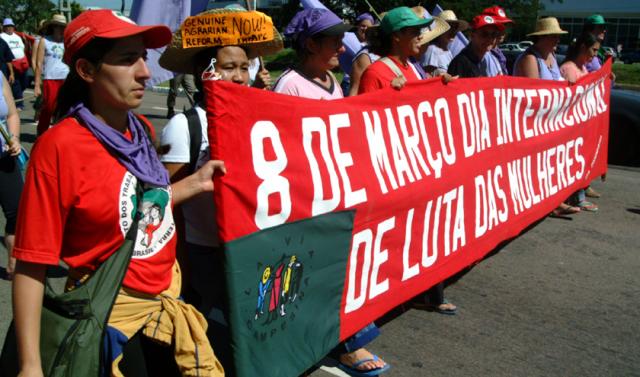
On the morning of March 8, 2006, 1,800 women from Via Campesina carried out a major action against the monoculture of eucalyptus in Rio Grande do Sul.